

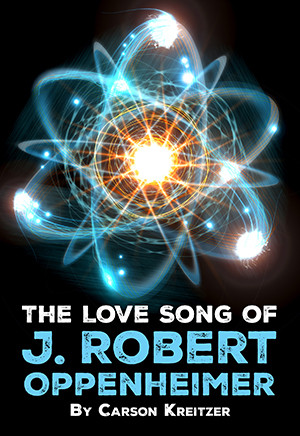
The Love Song of J. Robert Oppenheimer
By Carson Kreitzer.
Product Code: LD6000
Full-length Play
Drama
Cast size: 4m., 3w., with doubling. May be expanded to 7 or more m., 5w.
Awards: Lois and Richard Rosenthal New Play Prize
Rights and availability
This title can be licensed and sold in the following countries:
Australia, Canada, Netherlands, New Zealand, South Africa, United States
* Please note the royalty rate listed is the minimum royalty rate per performance. The actual royalty rate will be determined upon completion of a royalty application.
Synopsis
"Do I dare disturb the universe?" J. Robert Oppenheimer's rise and fall erupt in this kaleidoscopic play exploring questions of faith, conscience, and the consequences of the never-ending pursuit of knowledge. Act One: Math. The fevered wartime drive to build the first nuclear weapon, by a collection of previously academic theoretical physicists, many of them Jews fleeing Hitler's Germany. Success turns to horror when "the Gadget" is dropped, first on Hiroshima, then Nagasaki. Act Two: Aftermath. Oppenheimer confronts his conscience; Russia turns from ally to enemy. The Red scare is in full swing as we shift to the courtroom. Oppenheimer's wife, Kitty, drinks; J. Edger Hoover does the dance of the seven veils; and the Father of the Atomic Bomb has his security clearance revoked, cast out of the world he helped create. In a flash that is the end of his life, J. Robert Oppenheimer paces the desert of the Trinity Test Site, wrestling with his memories and one scary, sexy, unpredictable demon: Lilith, Hebrew mythology's first woman, cast out of Eden for refusing to behave. Hissing in his ear, she goads him to admit what he refuses to acknowledge: an anger that mirrors her own. "Oppie" is haunted by actions, decisions, and a trinity of women—mother, wife Kitty, and lover, Jean Tatlock. Her suicide is never far from his mind; her Communist ties are never far from the government's.
Details
- Status In stock
- Type of Show Full-length Play
- Product Code LD6000
- Minimum Cast Size 7
- Pages of Dialogue 88
- Min. Royalty Rate $100.00/perf
- Approx. Run Time 110 min
- Staging Unit set.
Categories
- Target Audience College and Adult
- Performing Group College Theatre | Community Theatre | Professional Theatre
- Genre Drama
- ISBN(13) 9781583423639
Customer Reviews
Media Reviews
"Kreitzer has a huge vision… Oppenheimer is superb theater." -The Cincinnati Enquirer"So much brilliance, ambivalence, ego, history, myth, science, moral argument, emotional heat, poetry and sheer dazzling theatricality are compressed into the mere two hours it takes for Carson Kreitzer's The Love Song of J. Robert Oppenheimer to detonate on the stage…that by the time it is all over, you might easily feel you’ve been exposed to dangerous levels of radiation." -Chicago Sun-Times
Synopsis
"Do I dare disturb the universe?" J. Robert Oppenheimer's rise and fall erupt in this kaleidoscopic play exploring questions of faith, conscience, and the consequences of the never-ending pursuit of knowledge. Act One: Math. The fevered wartime drive to build the first nuclear weapon, by a collection of previously academic theoretical physicists, many of them Jews fleeing Hitler's Germany. Success turns to horror when "the Gadget" is dropped, first on Hiroshima, then Nagasaki. Act Two: Aftermath. Oppenheimer confronts his conscience; Russia turns from ally to enemy. The Red scare is in full swing as we shift to the courtroom. Oppenheimer's wife, Kitty, drinks; J. Edger Hoover does the dance of the seven veils; and the Father of the Atomic Bomb has his security clearance revoked, cast out of the world he helped create. In a flash that is the end of his life, J. Robert Oppenheimer paces the desert of the Trinity Test Site, wrestling with his memories and one scary, sexy, unpredictable demon: Lilith, Hebrew mythology's first woman, cast out of Eden for refusing to behave. Hissing in his ear, she goads him to admit what he refuses to acknowledge: an anger that mirrors her own. "Oppie" is haunted by actions, decisions, and a trinity of women—mother, wife Kitty, and lover, Jean Tatlock. Her suicide is never far from his mind; her Communist ties are never far from the government's.
Details
- Status In stock
- Type of Show Full-length Play
- Product Code LD6000
- Minimum Cast Size 7
- Pages of Dialogue 88
- Min. Royalty Rate $100.00/perf
- Approx. Run Time 110 min
- Staging Unit set.
Categories
- Target Audience College and Adult
- Performing Group College Theatre | Community Theatre | Professional Theatre
- Genre Drama
- ISBN(13) 9781583423639
Customer Reviews
The play is a dynamic historical drama presented as a lyrical poem. The device of having Oppenheimer shadowed by Lilith highlights the brilliance and contradictions of the creator of the most horrific weapon in human history.
Media Reviews
"Kreitzer has a huge vision… Oppenheimer is superb theater." -The Cincinnati Enquirer"So much brilliance, ambivalence, ego, history, myth, science, moral argument, emotional heat, poetry and sheer dazzling theatricality are compressed into the mere two hours it takes for Carson Kreitzer's The Love Song of J. Robert Oppenheimer to detonate on the stage…that by the time it is all over, you might easily feel you’ve been exposed to dangerous levels of radiation." -Chicago Sun-Times
Also By These Authors


Jerry Oshinsky, Dijo Productions Theatre Company, Santa Barbara, Calif.